Carbon black is one of the most widely used industrial materials in the global manufacturing sector. As a critical reinforcing filler in rubber products, plastics, coatings, inks, and specialty applications, carbon black directly influences product durability, performance, conductivity, UV resistance, and processing efficiency.
For manufacturers, distributors, and procurement professionals, selecting the right carbon black grade is only part of the sourcing process. Proper packaging, handling, and transportation are equally important to maintain product quality, minimize material loss, and ensure safe delivery throughout the supply chain.
As a reliable carbon black supplier, understanding logistics and material management helps buyers secure consistent quality, reduce operational risks, and optimize production efficiency.
The Commercial Importance of Carbon Black
Global demand for industrial carbon black continues to grow due to expanding automotive, construction, infrastructure, plastics, and industrial manufacturing sectors.
Approximately 70% of carbon black production is consumed by the tire industry, where it enhances abrasion resistance, tensile strength, and durability. Beyond tires, carbon black is used in:
- Rubber hoses and belts
- Automotive components
- Plastic compounds
- Wire and cable insulation
- Industrial coatings
- Printing inks
- Conductive materials
For companies sourcing carbon black for rubber and tires, product consistency and supply reliability are critical because variations in carbon black properties can significantly affect final product performance.
Understanding Carbon Black Grades
Different carbon black grades are designed to provide specific reinforcement levels, processing characteristics, and performance properties.
N220 Carbon Black
N220 is a high-reinforcement grade with relatively small particle size and high surface area.
Typical Applications:
- High-performance tire treads
- Industrial rubber products
- Conveyor belts
- Mechanical rubber goods
Key Benefits:
- Excellent abrasion resistance
- High tensile strength
- Superior reinforcement properties
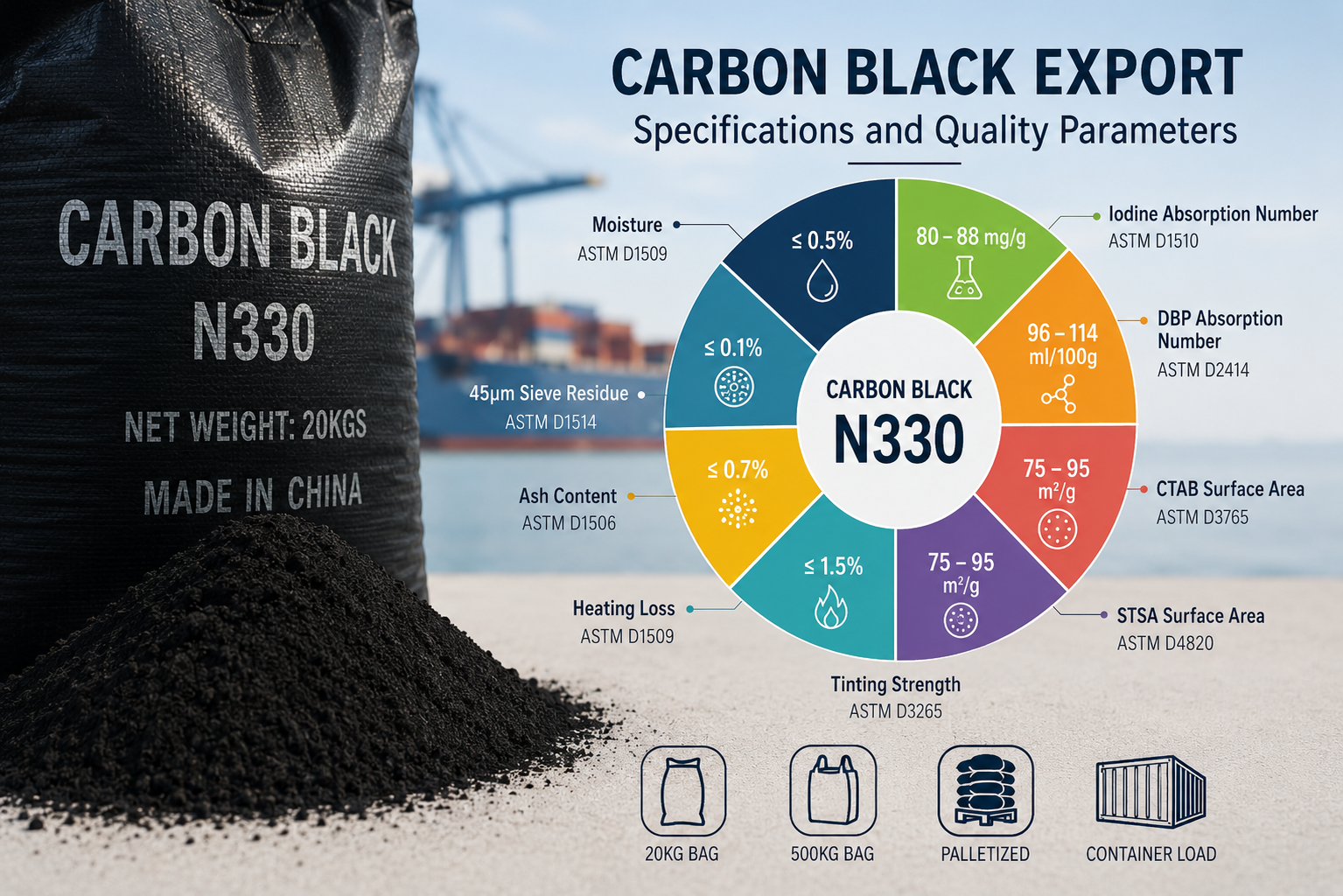
N330 Carbon Black
N330 is among the most commonly used carbon black grades worldwide.
Typical Applications:
- Passenger car tires
- Truck tires
- Rubber hoses
- Molded rubber products
Key Benefits:
- Balanced reinforcement
- Good processing characteristics
- Excellent wear resistance
N550 Carbon Black
N550 provides medium reinforcement and improved flexibility.
Typical Applications:
- Tire carcasses
- Sidewalls
- Industrial rubber goods
- Extruded rubber components
Key Benefits:
- Good resilience
- Lower heat buildup
- Enhanced flexibility
N660 Carbon Black
N660 is a low-reinforcement grade with larger particle size.
Typical Applications:
- Inner tubes
- Rubber footwear
- Gaskets
- Industrial molded products
Key Benefits:
- Improved elasticity
- Easier processing
- Lower compound viscosity
When sourcing bulk carbon black, manufacturers often evaluate multiple grades to match performance requirements and production objectives.
Carbon Black Packaging Options
Proper packaging protects carbon black from contamination, moisture exposure, and material loss during transportation and storage.
Paper Bags
Multi-wall paper bags are commonly used for smaller-volume shipments.
Advantages:
- Easy handling
- Suitable for containerized shipments
- Convenient warehouse storage
Typical packaging sizes include:
- 20 kg bags
- 25 kg bags
Jumbo Bags (FIBC)
Flexible Intermediate Bulk Containers (FIBC), commonly known as jumbo bags, are widely used for industrial shipments.
Advantages:
- Reduced packaging costs
- Faster loading and unloading
- Suitable for high-volume users
Typical capacities include:
- 500 kg
- 800 kg
- 1000 kg
Bulk Tanker Delivery
Large manufacturers often prefer pneumatic bulk delivery systems.
Advantages:
- Maximum efficiency
- Reduced labor requirements
- Lower packaging waste
- Improved inventory management
Bulk tanker delivery is especially attractive for tire manufacturers and major rubber processing facilities.
Best Practices for Carbon Black Handling
Carbon black is a lightweight powder that requires proper handling procedures to maintain product quality and workplace safety.
Prevent Moisture Exposure
Although carbon black is generally stable, moisture contamination can affect handling efficiency and processing consistency.
Recommended practices include:
- Store in dry warehouses
- Protect packaging from rain and humidity
- Maintain sealed containers after opening
Minimize Dust Generation
Carbon black particles can become airborne during handling.
Best practices include:
- Use enclosed conveying systems
- Employ dust collection equipment
- Follow facility safety procedures
- Utilize appropriate personal protective equipment
Inventory Management
Proper stock rotation helps maintain product quality and traceability.
Recommended methods include:
- First-In-First-Out (FIFO) inventory control
- Batch tracking
- Lot identification systems
Transportation Considerations for Carbon Black Export
For international shipments, logistics planning plays a major role in maintaining supply chain reliability.
Containerized Shipping
Container transport remains the most common method for carbon black export.
Advantages include:
- Protection from weather conditions
- Global availability
- Efficient customs processing
- Reduced contamination risk
Documentation Requirements
Professional suppliers provide complete shipment documentation to facilitate import procedures and quality verification.
Key documents typically include:
Certificate of Analysis (COA)
The COA confirms that the material meets specified quality parameters, including:
- Iodine adsorption number
- DBP absorption value
- Particle size characteristics
- Ash content
- Volatile matter
Material Safety Data Sheet (MSDS/SDS)
The MSDS or SDS provides information regarding:
- Safe handling procedures
- Storage recommendations
- Emergency response measures
- Regulatory compliance
Export Documentation
International shipments may also require:
- Commercial invoice
- Packing list
- Certificate of origin
- Bill of lading
- Customs documentation
Reliable documentation helps buyers reduce delays and maintain regulatory compliance.
What Bulk Buyers Look for When Sourcing Carbon Black
Procurement managers and manufacturers evaluate several critical factors before selecting a supplier.
Particle Size and Surface Area
Particle size directly influences:
- Reinforcement performance
- Wear resistance
- Conductivity
- Processing behavior
Higher surface area grades generally provide greater reinforcement.
Reinforcement Properties
For applications involving tires and industrial rubber goods, reinforcement characteristics are a primary purchasing consideration.
Buyers typically assess:
- Tensile strength
- Abrasion resistance
- Elongation properties
- Heat buildup performance
Consistent Quality
Manufacturers require predictable production outcomes.
Reliable suppliers maintain:
- Stable production standards
- Batch-to-batch consistency
- Quality control procedures
- Technical support
Packaging and Logistics Flexibility
Industrial customers often need customized supply solutions.
Preferred suppliers can offer:
- Bagged material
- Jumbo bags
- Bulk deliveries
- Container-load shipments
- Scheduled supply programs
Supply Reliability
Global manufacturers increasingly prioritize long-term supply security.
A dependable carbon black supplier should provide:
- Consistent inventory availability
- Export experience
- Global logistics support
- Responsive customer service
Choosing the Right Carbon Black Supply Partner
Selecting a supplier involves more than comparing prices. Successful sourcing strategies focus on technical performance, documentation quality, logistics capability, and long-term supply reliability.
An experienced supplier can help buyers identify the most suitable grade, optimize transportation methods, and ensure consistent product quality across every shipment.
Whether you require N220, N330, N550, N660, or other specialized grades, working with a trusted supplier helps support efficient manufacturing operations and stable production performance.
Learn More About Our Carbon Black Solutions
For detailed product information, visit our Carbon Black Product Page.
To discuss sourcing requirements, logistics solutions, or international shipments, visit our Contact Us Page.
Contact us for bulk supply.
Request technical specifications.
Inquire about available grades and export options.
about
Raykan
Together, let’s shape the future of industry. Focused on Reliability, Quality & Value