Introduction
Carbon Black is one of the most widely used industrial raw materials in the global manufacturing sector. It plays a critical role in enhancing the performance, durability, conductivity, and UV resistance of various products, particularly rubber compounds, tires, plastics, coatings, inks, and industrial goods.
As global demand for high-performance materials continues to grow, manufacturers and distributors increasingly seek reliable sources of industrial carbon black that meet strict quality standards and export specifications. Whether sourcing bulk carbon black for tire production or specialty applications, buyers must evaluate technical parameters, consistency, documentation, and supply reliability before making procurement decisions.
This article explains the key export specifications and quality parameters of Carbon Black, the differences between major grades, and the factors international buyers should consider when selecting a trusted carbon black supplier.
Understanding Carbon Black and Its Commercial Importance
Carbon Black is a fine black powder produced through the controlled incomplete combustion of heavy petroleum products. Its primary function is to improve the mechanical properties of rubber products while also providing pigmentation, conductivity, and UV protection.
Today, Carbon Black is an essential ingredient in:
- Tire manufacturing
- Automotive rubber components
- Industrial rubber goods
- Plastic compounds
- Printing inks
- Paints and coatings
- Cable and wire insulation
The largest share of global demand comes from carbon black for rubber and tires, where it acts as a reinforcing filler that significantly improves strength, abrasion resistance, and product lifespan.
As manufacturing industries expand across Asia, Europe, Africa, and the Americas, the market for carbon black export continues to grow, creating opportunities for importers, distributors, and OEM manufacturers seeking dependable supply partners.
Key Carbon Black Export Specifications
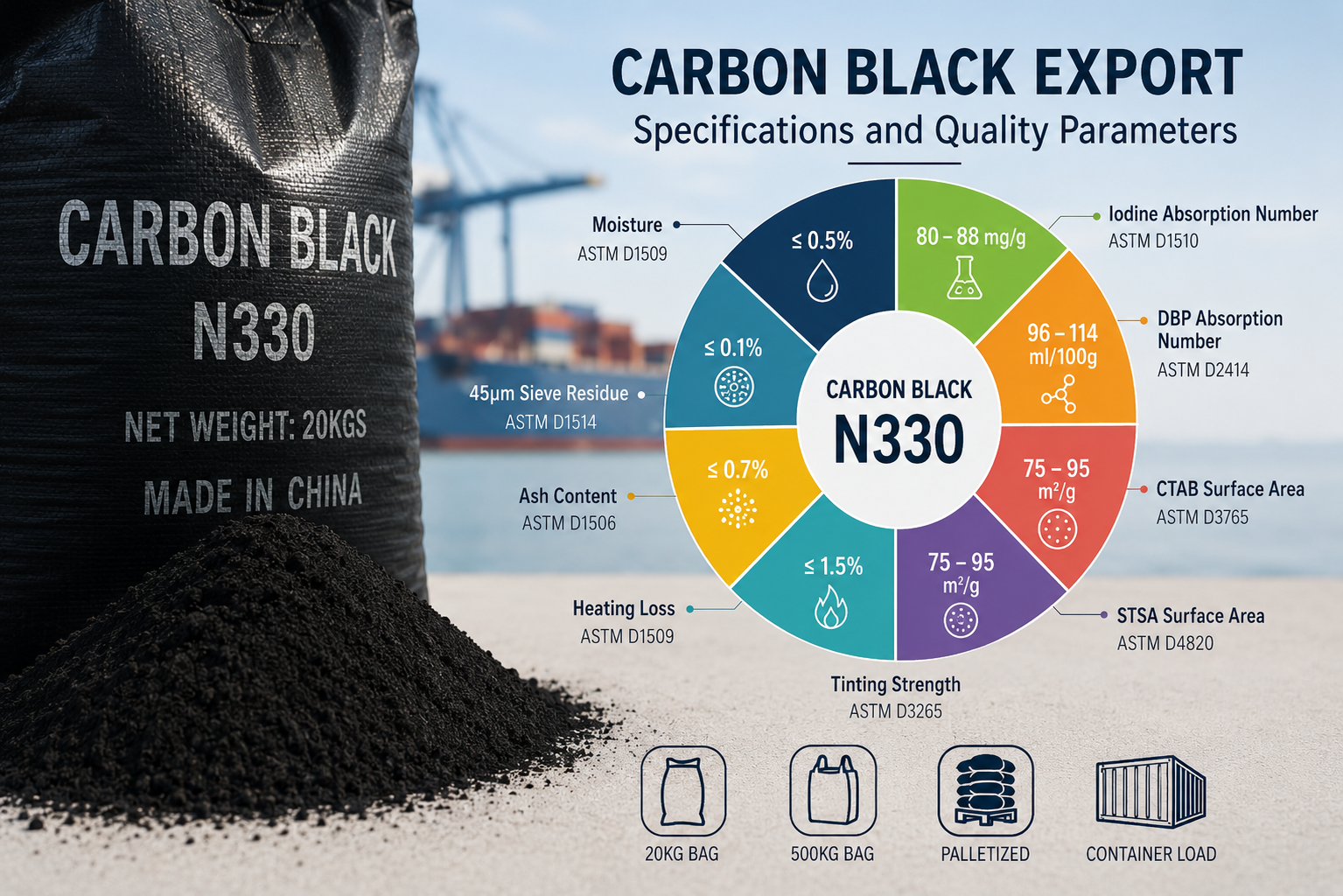
When evaluating Carbon Black for international procurement, buyers typically review a set of technical specifications that directly influence performance and processing characteristics.
Particle Size
Particle size is one of the most important quality indicators.
Smaller particle sizes generally provide:
- Higher reinforcement
- Improved tensile strength
- Better wear resistance
- Enhanced durability
Larger particle sizes often offer:
- Easier processing
- Lower heat buildup
- Improved flexibility
Particle size directly affects the suitability of Carbon Black for different industrial applications.
Surface Area
Surface area is commonly measured using nitrogen adsorption methods.
Higher surface area grades typically provide:
- Stronger reinforcement
- Improved mechanical properties
- Better abrasion resistance
Lower surface area grades are often selected for applications requiring flexibility and reduced processing complexity.
Structure
Carbon Black structure refers to the degree of aggregation of particles.
Higher-structure grades may provide:
- Better conductivity
- Improved reinforcement
- Enhanced processing characteristics
The required structure level varies according to the end-use application.
Reinforcement Properties
For rubber applications, reinforcement performance is a primary purchasing consideration.
Key benefits include:
- Increased tensile strength
- Improved tear resistance
- Better abrasion resistance
- Longer product life
- Enhanced load-bearing capability
These properties are especially important in tire manufacturing and heavy-duty industrial rubber products.
Ash Content
Low ash content is generally preferred because it indicates product purity and minimizes contamination in manufacturing processes.
Moisture Content
Controlled moisture levels help maintain product consistency, handling efficiency, and processing performance.
Pellet Strength
For pelletized Carbon Black, pellet strength is an important logistics and handling parameter.
Proper pellet strength helps:
- Reduce dust generation
- Improve storage stability
- Facilitate bulk transportation
- Enhance feeding performance during production
Common Carbon Black Grades and Applications
Different grades are designed to deliver specific performance characteristics.
N220 Carbon Black
N220 is a highly reinforcing grade with relatively small particle size and high surface area.
Typical applications include:
- High-performance tire treads
- Premium rubber compounds
- Conveyor belts
- Heavy-duty industrial rubber products
Benefits:
- Excellent abrasion resistance
- High tensile strength
- Superior reinforcement
N330 Carbon Black
N330 is among the most widely used Carbon Black grades globally.
Typical applications include:
- Passenger vehicle tires
- Industrial rubber goods
- Hoses
- Seals and gaskets
Benefits:
- Balanced reinforcement
- Good processability
- Excellent durability
Its versatility makes it a preferred choice for many manufacturers sourcing bulk carbon black.
N550 Carbon Black
N550 provides medium reinforcement and good processing characteristics.
Typical applications include:
- Tire carcasses
- Rubber mats
- Extruded rubber products
- Automotive components
Benefits:
- Good flexibility
- Reduced heat buildup
- Reliable mechanical performance
N660 Carbon Black
N660 is a lower-reinforcing grade with larger particle size.
Typical applications include:
- Inner tubes
- Mechanical rubber goods
- Wire and cable compounds
- General-purpose rubber products
Benefits:
- Excellent processability
- Improved flexibility
- Lower compound viscosity
What Bulk Buyers Look for When Sourcing Carbon Black
Successful procurement involves more than selecting the correct grade. Importers and manufacturers typically evaluate several commercial and technical factors.
Consistent Product Quality
Consistency is essential for maintaining production efficiency and product performance.
Buyers generally seek suppliers capable of delivering:
- Uniform particle distribution
- Stable physical properties
- Consistent batch-to-batch performance
- Reliable manufacturing standards
Quality consistency reduces production risks and minimizes formulation adjustments.
Reliable Supply Capacity
Large manufacturers require uninterrupted material availability.
A dependable carbon black supplier should offer:
- Stable production capability
- Long-term supply agreements
- Export experience
- Flexible shipment scheduling
Reliable supply helps buyers avoid costly production disruptions.
Packaging Options
Export packaging requirements vary according to customer needs and transportation methods.
Common packaging formats include:
- 25 kg bags
- 500 kg jumbo bags
- 1 MT FIBC bags
- Bulk tanker shipments
Appropriate packaging protects product quality during international transportation and storage.
Export Logistics and Documentation
Professional exporters provide complete documentation to support customs clearance and quality verification.
Important documents include:
Certificate of Analysis (COA)
The COA verifies that each shipment complies with agreed technical specifications and quality standards.
Material Safety Data Sheet (MSDS)
The MSDS provides safety, handling, storage, and transportation information required by manufacturers and regulatory authorities.
Additional export documents may include:
- Commercial Invoice
- Packing List
- Certificate of Origin
- Bill of Lading
- Quality Certificates
Comprehensive documentation simplifies international trade procedures and increases buyer confidence.
Carbon Black Quality Control for Export Markets
Leading exporters implement rigorous quality control procedures throughout production and shipment processes.
Typical testing parameters include:
- Iodine adsorption number
- DBP absorption value
- Surface area measurement
- Ash content
- Moisture content
- Pellet hardness
- Particle size distribution
- Tint strength
These quality controls ensure compliance with customer specifications and international industry requirements.
Choosing the Right Carbon Black Supplier
Selecting the right supplier is a strategic procurement decision.
Key evaluation criteria include:
- Product quality consistency
- Available grade portfolio
- Export experience
- Technical support capability
- Supply reliability
- Competitive pricing
- Documentation compliance
- Logistics expertise
A qualified supplier should understand both technical performance requirements and international trade procedures.
Conclusion
Carbon Black remains a vital industrial material used across the tire, rubber, plastics, coatings, and manufacturing sectors. As global demand for industrial carbon black continues to increase, buyers must carefully evaluate export specifications, quality parameters, and supplier capabilities.
Understanding factors such as particle size, surface area, reinforcement performance, and grade selection helps manufacturers choose the most suitable material for their applications. Grades such as N220, N330, N550, and N660 each provide distinct performance advantages for specific industrial requirements.
For companies involved in carbon black export, maintaining consistent quality, dependable supply chains, proper packaging, and complete documentation is essential for building long-term business relationships and supporting customer success worldwide.
Contact us for bulk supply of Carbon Black tailored to your manufacturing requirements.
Request technical specifications and product documentation, including COA and MSDS.
Inquire about available grades and export options to find the right Carbon Black solution for your market.
about
Raykan
Together, let’s shape the future of industry. Focused on Reliability, Quality & Value