Carbon black remains one of the most important industrial raw materials used across the global manufacturing sector. As a critical reinforcing and performance-enhancing additive, carbon black plays a vital role in the production of tires, rubber goods, plastics, coatings, inks, and various specialty applications. With continued growth in automotive manufacturing, infrastructure development, and industrial production, global demand for carbon black continues to expand.
For manufacturers, distributors, and procurement professionals, understanding market trends, product grades, and sourcing requirements is essential when selecting a reliable carbon black supplier for long-term supply partnerships.
What Is Carbon Black and Why Is It Important?
Carbon black is a fine black powder produced through the controlled incomplete combustion or thermal decomposition of hydrocarbon feedstocks. Its unique physical and chemical properties make it an indispensable ingredient in numerous industrial applications.
Key benefits of industrial carbon black include:
- Enhanced tensile strength and durability
- Improved abrasion resistance
- UV protection and weather resistance
- Electrical conductivity in specialized applications
- Consistent pigmentation and color performance
- Improved product lifespan and performance
Approximately 70% of global carbon black consumption is attributed to tire manufacturing, making carbon black for rubber and tires one of the largest market segments worldwide.
Global Carbon Black Market Overview
The global carbon black market continues to experience steady growth, supported by increasing industrialization and expanding manufacturing activities across emerging and developed economies.
Several factors are driving market demand:
Growth in Tire Manufacturing
The automotive industry remains the largest consumer of carbon black. Rising vehicle production and replacement tire demand continue to support significant consumption levels worldwide.
As tire manufacturers seek improved durability, fuel efficiency, and wear resistance, high-performance carbon black grades remain critical components in tire formulations.
Expansion of Rubber Goods Production
Beyond tires, carbon black is widely used in:
- Conveyor belts
- Industrial hoses
- Gaskets and seals
- Rubber flooring
- Automotive rubber components
These applications require reliable reinforcement properties and consistent product quality.
Increasing Demand from Plastics and Polymer Industries
Carbon black is commonly incorporated into plastic products to provide:
- UV stabilization
- Color consistency
- Electrical conductivity
- Enhanced durability
Growing demand for construction materials, packaging products, and industrial plastics contributes to increased consumption of industrial carbon black globally.
Infrastructure and Construction Development
Large-scale infrastructure projects stimulate demand for cables, pipes, coatings, roofing materials, and construction products that utilize carbon black for improved performance and longevity.
Understanding Major Carbon Black Grades
Different carbon black grades are engineered to provide specific reinforcement, processing, and performance characteristics. Selecting the appropriate grade depends on the intended application.
N220 Carbon Black
N220 is a highly reinforcing grade characterized by:
- Small particle size
- High surface area
- Excellent abrasion resistance
- Superior tensile strength
Common applications include:
- High-performance tire treads
- Heavy-duty truck tires
- Industrial rubber products requiring maximum durability
N220 is often selected where premium wear resistance and reinforcement are required.
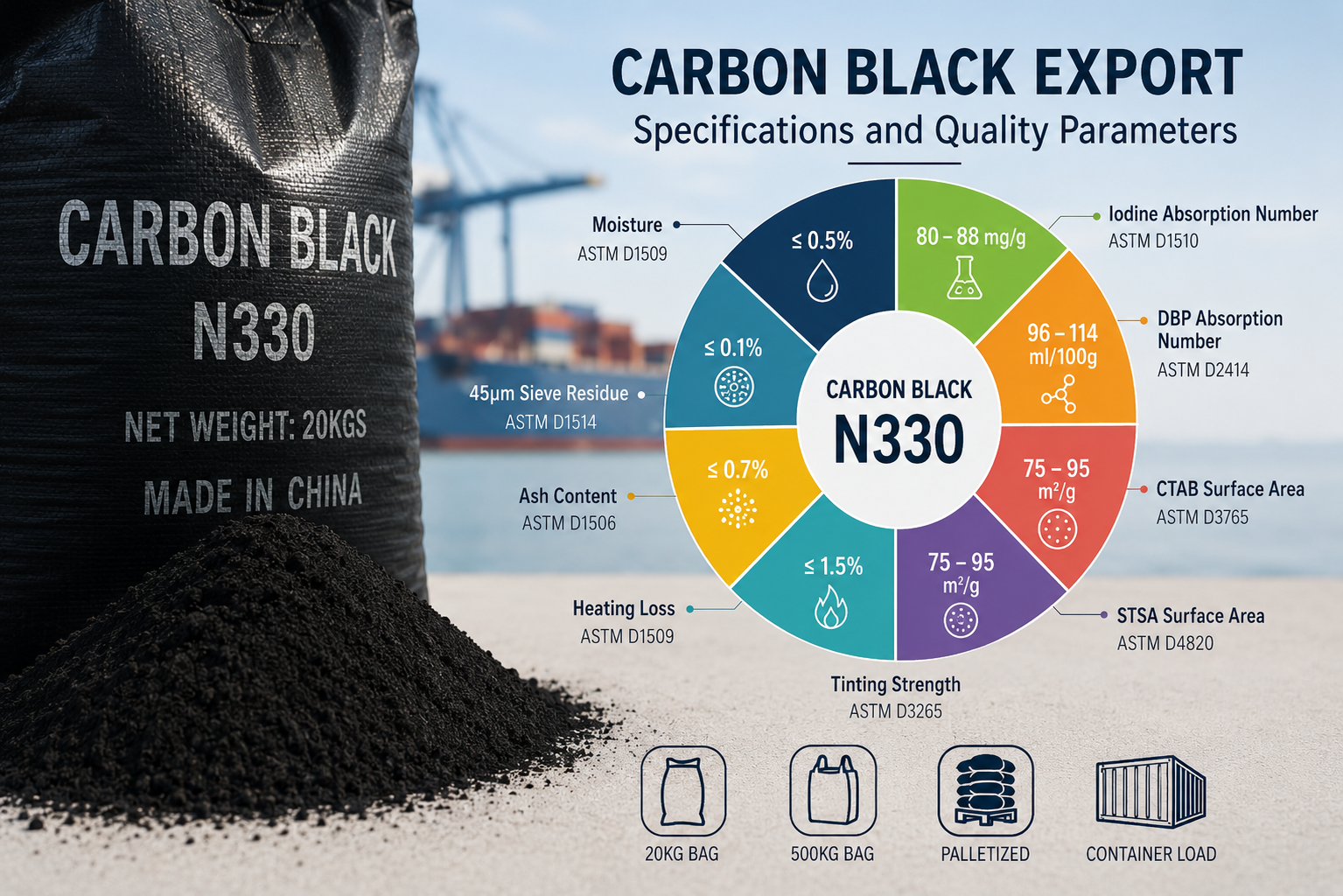
N330 Carbon Black
N330 is among the most widely used grades globally.
Key characteristics include:
- Balanced reinforcement properties
- Good processability
- Excellent tensile strength
- Consistent performance
Applications:
- Passenger vehicle tires
- Rubber hoses
- Belts
- Molded rubber goods
Its versatility makes N330 a preferred choice for many manufacturers.
N550 Carbon Black
N550 provides moderate reinforcement with improved flexibility.
Benefits include:
- Good resilience
- Lower heat buildup
- Enhanced processing characteristics
Applications:
- Tire carcasses
- Industrial rubber products
- Extruded rubber components
- General-purpose rubber compounds
Manufacturers often use N550 when balancing performance and cost efficiency.
N660 Carbon Black
N660 is a semi-reinforcing grade known for:
- Larger particle size
- Lower surface area
- Good flexibility
- Improved dynamic properties
Common uses include:
- Inner tire components
- Mechanical rubber goods
- Rubber mats
- Industrial vibration-control products
This grade is frequently selected for applications requiring flexibility rather than maximum reinforcement.
Key Factors Buyers Consider When Sourcing Carbon Black
Successful procurement goes beyond price. Experienced buyers evaluate multiple technical and commercial factors before selecting a carbon black supplier.
Particle Size and Surface Area
Particle size and surface area significantly influence:
- Reinforcement performance
- Abrasion resistance
- Processing characteristics
- Dispersion quality
Smaller particle grades generally provide stronger reinforcement, while larger particle grades offer greater flexibility and easier processing.
Reinforcement Properties
Different applications require varying levels of reinforcement.
Buyers often evaluate:
- Tensile strength
- Modulus
- Wear resistance
- Elasticity
- Heat buildup characteristics
Selecting the proper grade ensures optimal product performance and manufacturing efficiency.
Consistent Quality and Supply Reliability
Consistency is critical in industrial production.
Manufacturers seek suppliers capable of delivering:
- Uniform product specifications
- Stable batch-to-batch quality
- Long-term supply agreements
- Reliable inventory management
Supply disruptions can significantly affect production schedules and customer commitments.
Packaging Options and Logistics
For bulk carbon black purchases, logistics efficiency plays a major role in procurement decisions.
Common packaging options include:
- 20 kg bags
- 25 kg bags
- Jumbo bags (FIBCs)
- Bulk tanker deliveries
International buyers also assess:
- Export documentation
- Shipping lead times
- Container loading optimization
- Port availability
Reliable carbon black export capabilities help ensure uninterrupted supply chains.
Technical Documentation
Professional buyers typically require complete documentation, including:
- Certificate of Analysis (COA)
- Material Safety Data Sheet (MSDS/SDS)
- Technical Data Sheets (TDS)
- Product specifications
- Quality certifications
Accurate documentation supports compliance, quality control, and regulatory requirements.
Carbon Black Trade and Export Opportunities
Global trade continues to play a major role in the carbon black industry. Many manufacturers and distributors rely on international sourcing strategies to secure competitive pricing and diversified supply options.
A reliable carbon black export partner can provide:
- Access to multiple grades
- Consistent inventory availability
- Flexible packaging solutions
- International shipping support
- Technical documentation assistance
As industries continue expanding across Asia, the Middle East, Africa, Europe, and Latin America, opportunities for cross-border carbon black supply remain strong.
Choosing the Right Carbon Black Supplier
Selecting the right supplier involves evaluating both technical expertise and supply chain capabilities.
Key criteria include:
- Availability of major grades such as N220, N330, N550, and N660
- Consistent product quality
- Competitive commercial terms
- Strong logistics support
- Export experience
- Responsive technical assistance
- Complete COA and MSDS documentation
Long-term partnerships with dependable suppliers help manufacturers maintain production efficiency and product quality standards.
Conclusion
Carbon black continues to be a foundational material across the global rubber, tire, plastics, and industrial manufacturing sectors. Growing automotive production, infrastructure development, and industrial expansion are expected to support continued demand worldwide.
Whether sourcing carbon black for rubber and tires, industrial compounds, or specialty applications, buyers increasingly prioritize quality consistency, technical performance, supply reliability, and export capability.
Organizations seeking bulk carbon black should work with experienced suppliers capable of delivering the appropriate grades, documentation, logistics support, and long-term supply stability.
Contact us for bulk supply.
Request technical specifications for available carbon black grades.
Inquire about available grades and export options.
about
Raykan
Together, let’s shape the future of industry. Focused on Reliability, Quality & Value