Carbon black is one of the most important industrial additives used in rubber manufacturing. From passenger car tires and conveyor belts to automotive components and industrial hoses, carbon black significantly enhances the performance, durability, and service life of rubber products.
As global industries continue to demand high-performance rubber compounds, the need for reliable carbon black suppliers and consistent sources of industrial carbon black remains strong. Understanding how carbon black functions in rubber formulations and selecting the right grade are critical factors for manufacturers, distributors, and procurement professionals seeking quality and cost efficiency.
What Is Carbon Black?
Carbon black is a fine black powder produced through the controlled incomplete combustion or thermal decomposition of hydrocarbons. It consists primarily of elemental carbon and is widely used as a reinforcing filler in rubber compounds.
While carbon black is also utilized in plastics, coatings, inks, and batteries, the rubber industry accounts for the majority of global consumption. The material provides a unique combination of reinforcement, abrasion resistance, conductivity, UV protection, and durability that cannot be easily replicated by alternative fillers.
Why Carbon Black Is Essential in Rubber Compounds
The primary function of carbon black in rubber is reinforcement. When incorporated into rubber formulations, it improves several critical mechanical and physical properties.
Enhanced Tensile Strength
Carbon black strengthens the rubber matrix, enabling finished products to withstand higher loads and stresses without failure.
Improved Abrasion Resistance
Tires, conveyor belts, and industrial rubber products experience constant wear. Carbon black significantly improves resistance to abrasion, extending product lifespan.
Better Tear Resistance
Rubber compounds containing suitable carbon black grades exhibit enhanced resistance to tearing and cracking under demanding operating conditions.
Increased Durability
The addition of carbon black improves long-term performance by protecting rubber against environmental degradation, UV exposure, and oxidation.
Optimized Processing
Carbon black can improve processing characteristics during mixing, extrusion, and molding operations, helping manufacturers achieve consistent production quality.
Commercial Importance of Carbon Black
Carbon black remains a strategic raw material for the global rubber industry. Growing automotive production, infrastructure development, mining operations, and industrial manufacturing continue to drive demand for carbon black for rubber and tires.
Key sectors consuming carbon black include:
- Tire manufacturing
- Automotive rubber parts
- Industrial belts
- Conveyor systems
- Hoses and tubing
- Rubber seals and gaskets
- Construction materials
- Mining equipment components
As supply chains become increasingly globalized, buyers often seek experienced partners capable of supporting carbon black export requirements while maintaining product consistency and regulatory compliance.
Common Carbon Black Grades and Applications
Selecting the appropriate grade is essential because each carbon black type offers different performance characteristics based on particle size, structure, and surface area.
N220 Carbon Black
N220 is a high-reinforcement grade with relatively small particle size and high surface area.
Key Benefits
- Excellent abrasion resistance
- High tensile strength
- Superior reinforcement
- Enhanced wear performance
Typical Applications
- Premium tire tread compounds
- Heavy-duty truck tires
- High-performance rubber products
- Industrial wear-resistant components
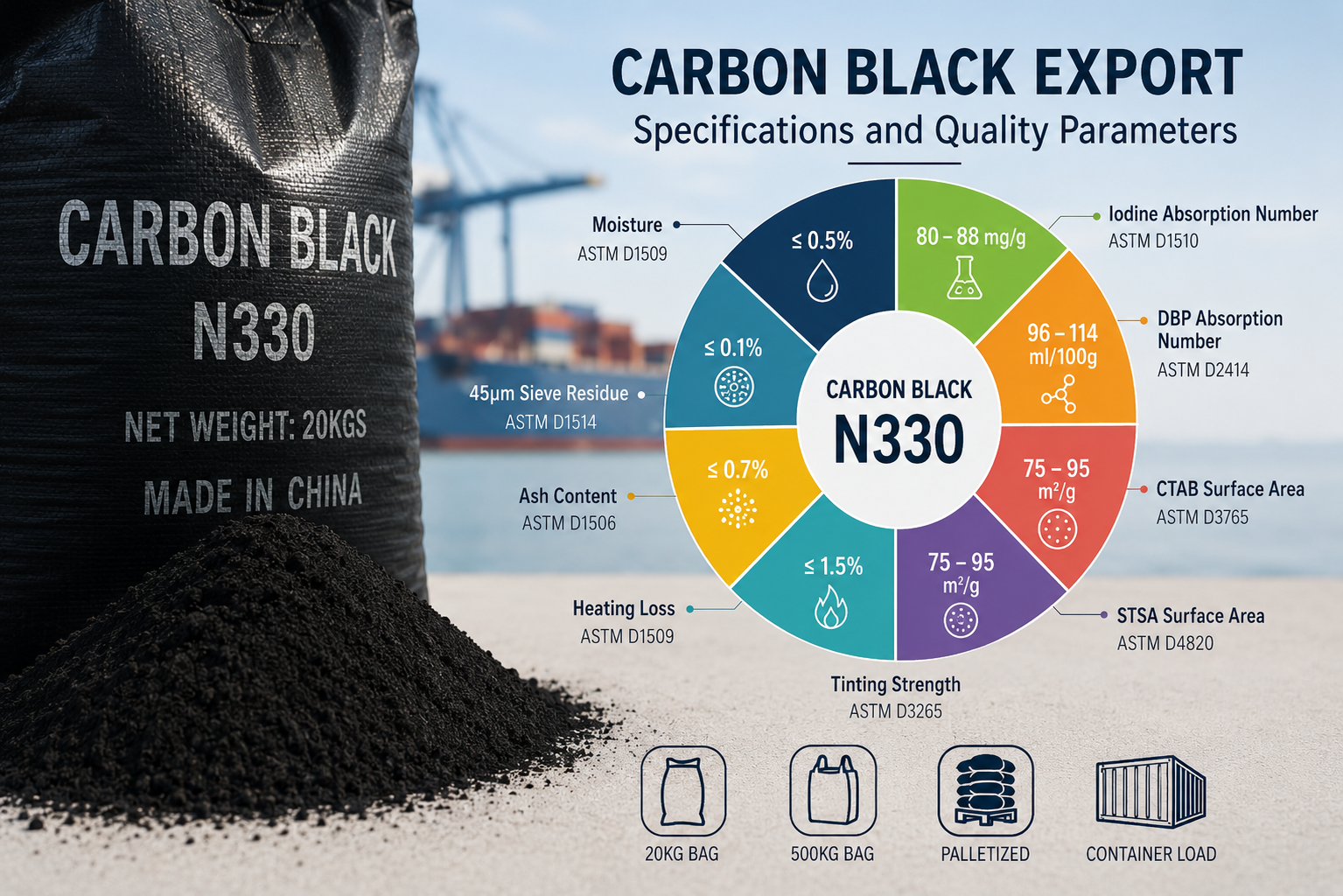
N330 Carbon Black
N330 is one of the most widely used carbon black grades worldwide due to its balanced performance characteristics.
Key Benefits
- Good reinforcement
- Excellent processability
- Balanced wear resistance
- Cost-effective performance
Typical Applications
- Passenger car tires
- Sidewalls
- Hoses
- Belts
- General-purpose rubber goods
Because of its versatility, N330 is frequently requested by manufacturers sourcing bulk carbon black for multiple production lines.
N550 Carbon Black
N550 offers moderate reinforcement with improved flexibility compared to higher-reinforcement grades.
Key Benefits
- Good resilience
- Improved flexibility
- Lower heat buildup
- Balanced mechanical properties
Typical Applications
- Tire carcasses
- Industrial rubber products
- Extruded rubber profiles
- Automotive rubber components
N660 Carbon Black
N660 features larger particle size and lower surface area, providing lower reinforcement and excellent processing characteristics.
Key Benefits
- Improved elasticity
- Reduced heat generation
- Good dynamic performance
- Economical formulation option
Typical Applications
- Inner tubes
- Mechanical rubber goods
- Cushion compounds
- Industrial molded products
Key Factors Buyers Consider When Sourcing Carbon Black
Whether purchasing for manufacturing operations or distribution networks, professional buyers evaluate several critical criteria before selecting a carbon black supplier.
Particle Size and Surface Area
Particle size directly affects reinforcement performance.
Generally:
- Smaller particle size = higher reinforcement
- Larger particle size = improved flexibility and processability
Surface area also influences mechanical properties, wear resistance, and compound performance.
Manufacturers typically select grades based on specific end-use requirements rather than price alone.
Reinforcement Properties
The reinforcement capability of carbon black determines the final performance of rubber products.
Buyers often evaluate:
- Tensile strength
- Abrasion resistance
- Tear resistance
- Modulus
- Heat buildup characteristics
- Dynamic performance
The correct grade selection helps optimize both product quality and production costs.
Consistent Quality and Supply Reliability
For large-scale production facilities, consistency is essential.
Reliable suppliers should provide:
- Stable specifications
- Batch-to-batch consistency
- Regular quality testing
- Long-term supply capability
- Global logistics support
Supply interruptions can affect manufacturing schedules and customer commitments, making supplier reliability a critical purchasing factor.
Packaging Options and Logistics
Industrial buyers often require flexible packaging solutions based on storage, transportation, and consumption needs.
Common packaging options include:
- 20 kg bags
- 25 kg bags
- Jumbo bags
- Bulk loading systems
- Containerized export shipments
Efficient logistics support is especially important for international customers involved in carbon black export transactions.
Documentation and Compliance
Professional suppliers should provide complete technical documentation.
Common requirements include:
- Certificate of Analysis (COA)
- Material Safety Data Sheet (MSDS/SDS)
- Technical Data Sheets (TDS)
- Product specifications
- Regulatory compliance documentation
Proper documentation helps buyers meet quality assurance, safety, and regulatory requirements.
Global Demand for Carbon Black
The worldwide demand for industrial carbon black continues to expand due to several market drivers:
- Growth in automotive production
- Expansion of transportation infrastructure
- Increasing tire replacement demand
- Rising industrial manufacturing activity
- Growth in emerging economies
The tire sector remains the largest consumer, accounting for the majority of carbon black usage globally. As vehicle ownership increases and transportation networks expand, demand for reliable carbon black supply is expected to remain strong.
Choosing the Right Carbon Black Supplier
Selecting a trusted supplier goes beyond pricing considerations.
Manufacturers and distributors typically seek partners that offer:
- Multiple carbon black grades
- Consistent quality standards
- Reliable export capabilities
- Technical support
- Flexible packaging options
- Responsive customer service
- Complete documentation
An experienced supplier can help buyers identify suitable grades, optimize formulations, and maintain uninterrupted production schedules.
Conclusion
Carbon black plays a vital role in improving the strength, durability, abrasion resistance, and overall performance of rubber compounds. From high-reinforcement grades such as N220 and N330 to more flexible options like N550 and N660, selecting the correct grade is essential for achieving desired product characteristics.
As global demand for carbon black for rubber and tires continues to grow, manufacturers, distributors, and procurement teams increasingly prioritize quality consistency, supply reliability, technical documentation, and efficient logistics when sourcing materials.
For companies seeking dependable bulk carbon black supply, working with an experienced carbon black supplier can help ensure product performance, operational efficiency, and long-term business success.
Contact us for bulk supply.
Request technical specifications and product documentation.
Inquire about available grades and export options.
about
Raykan
Together, let’s shape the future of industry. Focused on Reliability, Quality & Value