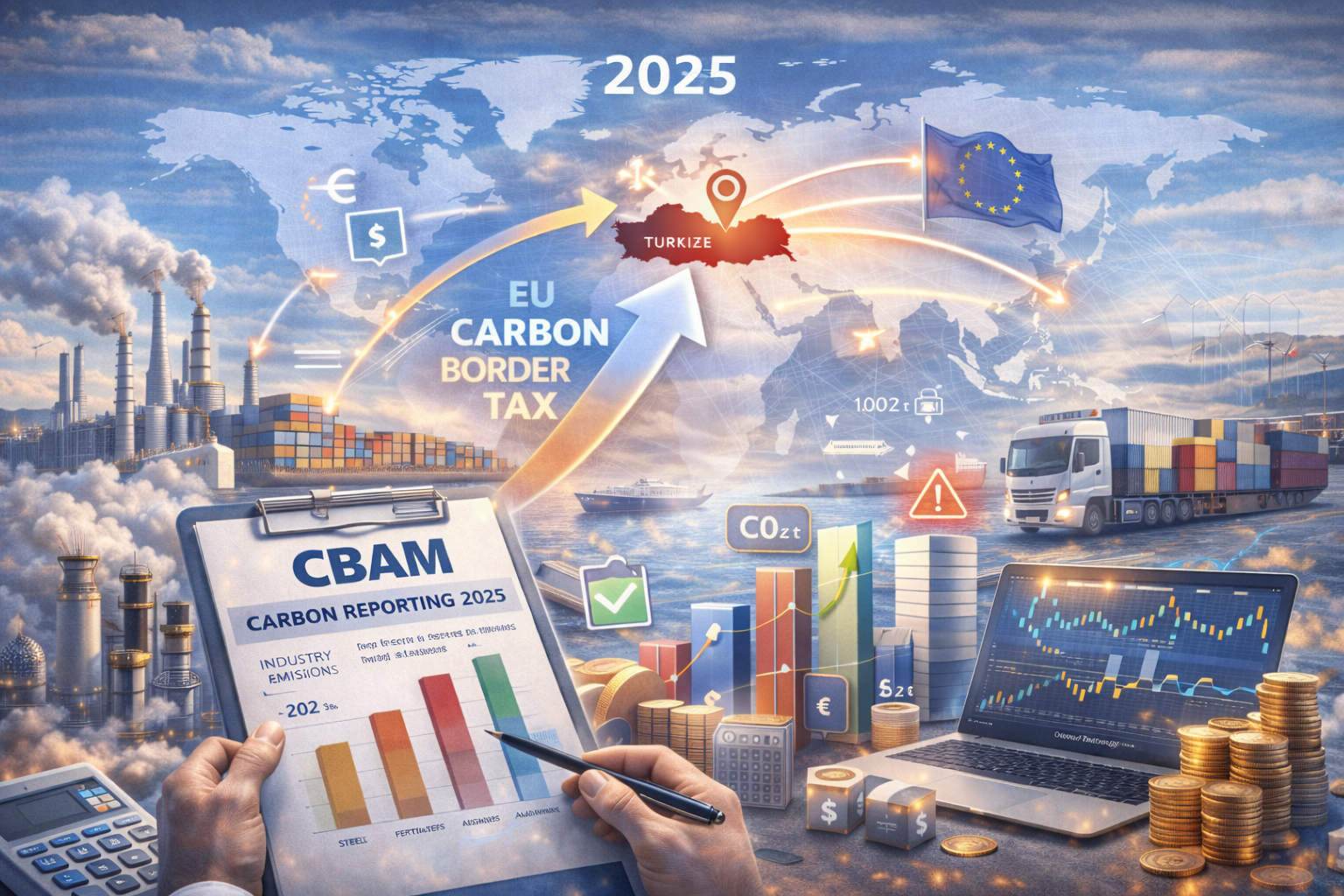
CBAM impact on trade 2025 is now a real commercial issue, as carbon emissions reporting and future carbon costs begin reshaping how industrial goods are priced, sourced, and sold into the European Union.
The Carbon Border Adjustment Mechanism (CBAM) is no longer a future policy or a regulatory theory. In 2025, CBAM has moved firmly into the operational phase, forcing exporters, importers, and industrial buyers to confront a new reality: carbon is now a trade cost.
For companies trading metals, fertilizers, cement, chemicals, and energy-intensive products into the European Union, CBAM is changing pricing structures, supplier selection, and contract negotiations. This is not just a compliance issue—it is a competitive filter that will reshape global industrial trade flows over the next decade.
This article explains the real CBAM impact on trade in 2025, what buyers and exporters must do now, and how sourcing hubs like Türkiye are adapting to the new carbon-adjusted trade environment.
1. What Changed in CBAM in 2025
CBAM entered its transitional reporting phase earlier, but 2025 is the year when financial exposure becomes visible.
Key developments in 2025:
| CBAM Element | Trade Impact |
|---|---|
| Mandatory emissions reporting | Increased admin & data cost |
| Verified carbon intensity data | Supplier transparency required |
| Embedded emissions calculation | Pricing complexity |
| Carbon price alignment | Margin pressure |
| Buyer liability awareness | Contract renegotiation |
While direct CBAM payments are still ramping up, buyers are already pricing in future carbon cost exposure. This affects purchasing decisions today.
2. Which Products Are Most Affected
CBAM currently targets carbon-intensive industrial goods, including:
-
Steel and iron products
-
Aluminum
-
Cement and clinker
-
Fertilizers (especially nitrogen-based)
-
Electricity
-
Hydrogen (in scope expansion)
These sectors sit at the core of global industrial trade. For exporters, CBAM compliance is no longer optional; for importers, ignoring carbon intensity is a commercial risk.
3. How CBAM Is Changing Buyer Behavior
European buyers are adjusting sourcing strategies in three clear ways:
1️⃣ Carbon Transparency Becomes a Selection Criterion
Price alone is no longer enough. Buyers now evaluate:
-
Emissions intensity per ton
-
Data reliability
-
Verification readiness
2️⃣ Shift Toward Regional & Transitional Suppliers
Suppliers closer to the EU—such as Türkiye—gain an advantage due to:
-
Shorter transport emissions
-
Easier data coordination
-
Faster compliance response
3️⃣ Contract Terms Are Being Rewritten
CBAM-related clauses now appear in contracts:
-
Carbon cost pass-through logic
-
Emissions data responsibility
-
Future CBAM adjustment mechanisms
CBAM is forcing carbon into the legal and commercial layer of trade.
4. Türkiye’s Position Under CBAM
Türkiye occupies a strategic middle position in the CBAM landscape.
Why this matters:
-
Strong industrial base in steel, fertilizers, aluminum, chemicals
-
Proximity to EU reduces transport-related emissions
-
Increasing alignment with EU standards
-
Faster adaptation compared to distant exporters
While CBAM increases reporting obligations for Turkish exporters, it also creates an opportunity: non-compliant competitors lose access or pricing power.
For buyers, sourcing from Türkiye can mean:
✔ Lower embedded emissions
✔ Better documentation
✔ Shorter lead times
✔ Reduced future CBAM exposure
5. Carbon Cost Is Becoming a Pricing Component
In 2025, CBAM introduces a new pricing layer:
Base price + logistics + carbon exposure = real landed cost
Buyers who ignore carbon cost risk:
-
Margin erosion
-
Contract disputes
-
Unexpected cost spikes
Advanced procurement teams now:
-
Request emissions data upfront
-
Model future CBAM cost scenarios
-
Compare suppliers on carbon-adjusted price
Carbon pricing is no longer theoretical—it is embedded into trade economics.
6. Compliance Strategy for Exporters & Traders
Winning under CBAM requires preparation, not reaction.
Key actions in 2025:
-
Map product-level emissions
-
Work with verifiers early
-
Align reporting systems
-
Communicate carbon data clearly to buyers
-
Integrate CBAM into pricing models
Exporters that treat CBAM as a paperwork exercise will struggle. Those that treat it as a strategic differentiator will gain market share.
7. What Comes Next: 2026 and Beyond
CBAM scope is expected to expand:
-
More chemical products
-
Downstream goods
-
Tighter verification rules
Companies that adapt in 2025 will face lower friction later. Those that delay will be forced into rushed, costly compliance.
Conclusion — CBAM Is a Trade Filter, Not Just a Tax
The CBAM impact on trade in 2025 goes far beyond reporting. It is reshaping who trades with Europe, at what price, and under which conditions.
Carbon transparency is becoming a market access requirement. Türkiye’s role as a compliant, regional supplier positions it well—but success depends on execution.
In the CBAM era, low-carbon readiness equals trade resilience.
Internal Linking Suggestions:
-
Raykan Products → /products
-
Logistics & Trade Services → /services
-
About Company → /about us
-
Contact → /contact us
about
Raykan
Together, let’s shape the future of industry. Focused on Reliability, Quality & Value