Introduction
Carbon black is one of the most important industrial raw materials used in modern manufacturing. Widely utilized in tires, rubber goods, plastics, inks, coatings, and conductive applications, it plays a critical role in improving durability, UV resistance, conductivity, and reinforcement performance.
Today, global demand for industrial carbon black continues to grow due to expanding automotive, infrastructure, and manufacturing industries. For buyers sourcing carbon black for rubber and tires, understanding how carbon black is manufactured can help evaluate quality, consistency, and supplier reliability.
Among several production methods, the Furnace Black Process is the most widely used worldwide because it offers excellent control over particle size, structure, and performance characteristics across different grades.
What Is Carbon Black?
Carbon black is a fine black powder produced through the incomplete combustion or thermal decomposition of hydrocarbons. Although composed primarily of elemental carbon, its manufacturing conditions determine critical properties such as:
- Particle size
- Surface area
- Structure
- Conductivity
- Reinforcement performance
These characteristics directly affect the performance of finished products, especially in rubber compounds and tire manufacturing.
Common applications include:
- Tires and automotive rubber parts
- Conveyor belts and hoses
- Plastics and masterbatch
- Printing inks and coatings
- Wire and cable compounds
- Industrial molded rubber products
For manufacturers seeking reliable product performance, selecting the correct carbon black grade is essential.
The Furnace Black Process Explained
What Is the Furnace Black Process?
The Furnace Black Process is the dominant industrial method for producing carbon black. In this process, heavy aromatic oils or petroleum-based feedstocks are injected into a high-temperature combustion reactor under controlled conditions.
The feedstock partially combusts and thermally decomposes, forming carbon black particles that are later cooled, collected, and pelletized.
This process allows manufacturers to produce a wide range of grades with controlled:
- Surface area
- Particle size distribution
- Structure
- Reinforcement properties
Because of its scalability and consistency, the furnace method is preferred for large-scale bulk carbon black production and international trade.
Step-by-Step Carbon Black Manufacturing Process
- Feedstock Preparation
The process begins with selecting suitable hydrocarbon feedstock oils, typically derived from petroleum refining or coal tar processing.
Feedstock quality significantly affects:
- Purity
- Particle formation
- Final product consistency
High-quality raw materials are essential for manufacturers requiring stable industrial formulations.
- Combustion and Reactor Heating
Inside the furnace reactor, fuel and air are combusted at temperatures that can exceed 1,400°C.
The reactor environment is carefully controlled to regulate:
- Temperature
- Residence time
- Air-to-fuel ratio
- Turbulence
These conditions determine the final carbon black characteristics.
- Injection of Feedstock Oil
The hydrocarbon feedstock is injected into the hot gas stream where thermal cracking occurs.
This decomposition forms microscopic carbon particles that aggregate into complex structures. Adjusting reactor parameters enables production of different carbon black grades with varying reinforcement capabilities.
- Quenching
Once the desired particle characteristics are achieved, water is injected to rapidly cool the reaction.
This “quenching” step stops particle growth and stabilizes the product properties.
- Collection and Filtration
The carbon black powder is separated from process gases using bag filters and cyclone systems.
At this stage, manufacturers evaluate:
- Particle consistency
- Purity
- Moisture levels
Reliable filtration systems are essential for producing high-quality industrial carbon black suitable for demanding applications.
- Pelletizing and Packaging
The powder is typically pelletized to improve:
- Handling
- Storage
- Transportation
- Feeding efficiency during manufacturing
Finished material is packed in:
- 20–25 kg bags
- Jumbo bags
- Bulk tanker shipments
Export-oriented suppliers often provide flexible packaging solutions depending on customer requirements and logistics preferences.
Common Carbon Black Grades and Applications
Different grades are produced by adjusting furnace operating conditions. The ASTM classification system identifies grades commonly used in the rubber industry.
N220 Carbon Black
N220 is a high-reinforcement grade with:
- Small particle size
- High surface area
- Excellent abrasion resistance
Typical applications:
- High-performance tire treads
- Industrial rubber products
- Performance compounds
This grade is widely used where durability and wear resistance are critical.
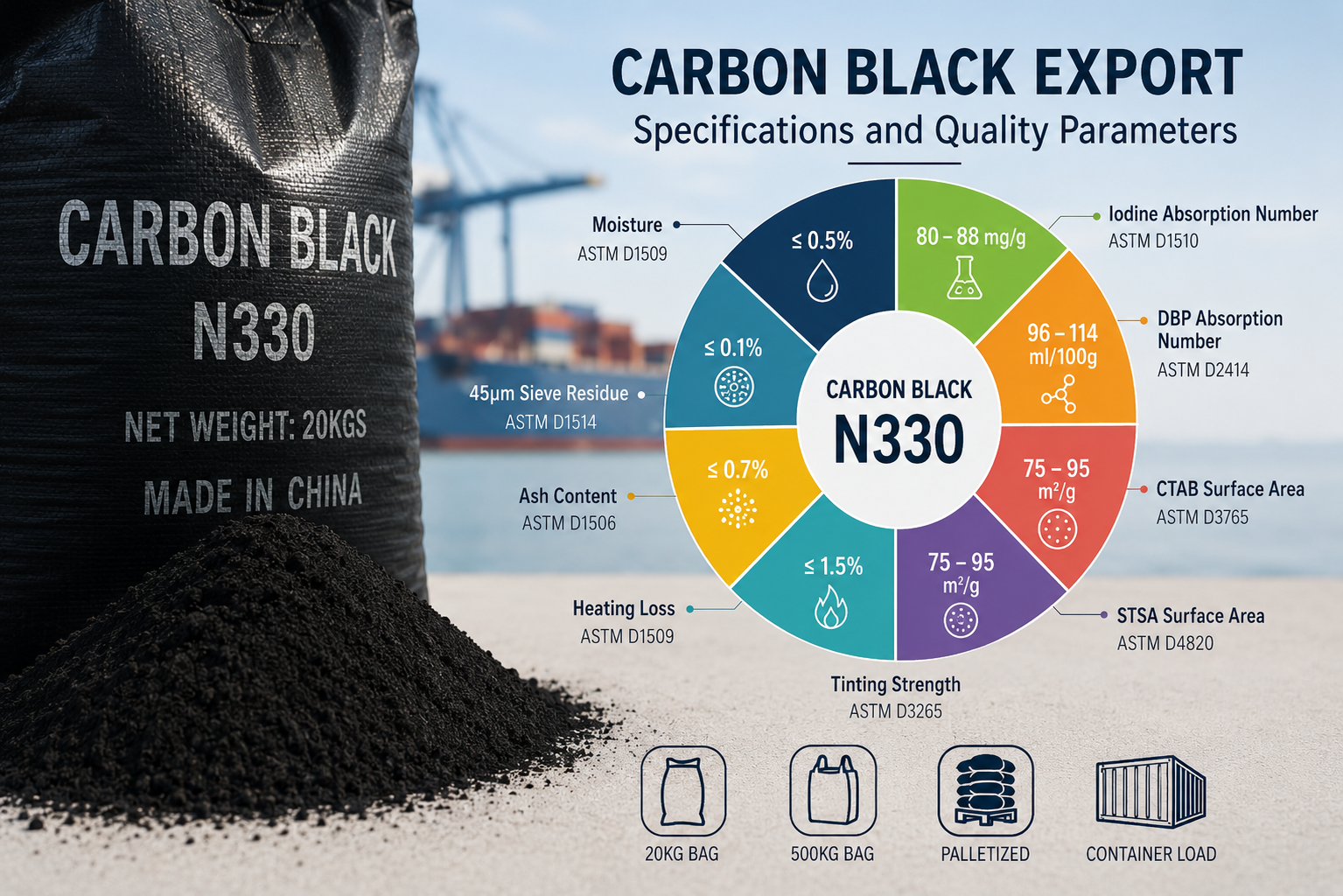
N330 Carbon Black
N330 is one of the most commonly used grades worldwide.
Key characteristics:
- Balanced reinforcement
- Good processability
- Strong tensile properties
Applications:
- Passenger car tires
- Sidewalls
- Hoses
- Rubber molded products
Many buyers sourcing carbon black for rubber and tires prioritize N330 because of its versatility and cost-performance balance.
N550 Carbon Black
N550 offers medium reinforcement and improved flexibility.
Common uses:
- Tire carcasses
- Conveyor belts
- Extruded rubber products
Manufacturers often select this grade for applications requiring balanced mechanical properties.
N660 Carbon Black
N660 features:
- Larger particle size
- Lower surface area
- Reduced reinforcement
Applications include:
- Inner tubes
- Mechanical rubber goods
- Flexible rubber compounds
This grade is valued for processing efficiency and lower compound heat buildup.
What Bulk Buyers Look for When Sourcing Carbon Black
Consistent Particle Size and Surface Area
Particle size and surface area directly influence:
- Reinforcement performance
- Wear resistance
- Conductivity
- Dispersion quality
Industrial buyers typically request detailed technical specifications before approving a supplier.
Reinforcement Performance
For tire and rubber manufacturers, reinforcement capability is a major purchasing factor.
High-quality carbon black improves:
- Tensile strength
- Abrasion resistance
- Tear resistance
- Product lifespan
Reliable suppliers maintain strict process controls to ensure consistent reinforcement characteristics across production batches.
Stable Supply and Export Reliability
Global manufacturers and distributors often prioritize suppliers with:
- Stable production capacity
- Export experience
- Consistent lead times
- Multi-country logistics capability
A dependable carbon black supplier should be able to support long-term contracts and recurring industrial demand.
Soft CTA:
Contact us for bulk supply and international export support.
Packaging and Logistics Flexibility
Industrial buyers may require different packaging formats depending on their production systems and storage capabilities.
Common export packaging includes:
- Paper bags
- PE-lined bags
- Jumbo bags
- Bulk container loading
Efficient logistics and documentation management are especially important for international shipments.
Documentation and Compliance
Professional buyers usually request:
- COA (Certificate of Analysis)
- MSDS/SDS documentation
- Technical Data Sheets
- REACH or regulatory compliance documents where applicable
Documentation transparency builds trust and simplifies import procedures.
Soft CTA:
Inquire about available grades and export documentation options.
Global Demand for Carbon Black
Worldwide demand for carbon black continues to expand due to growth in:
- Automotive manufacturing
- Tire production
- Infrastructure projects
- Plastic and polymer industries
Asia-Pacific remains the largest consumption region, while global trade opportunities continue to increase for reliable carbon black export suppliers.
As industries focus more on product durability and manufacturing efficiency, high-performance carbon black grades remain essential industrial materials.
Choosing the Right Carbon Black Supplier
Selecting the right supplier involves more than pricing alone. Procurement teams typically evaluate:
- Product consistency
- Technical support
- Manufacturing standards
- Export capability
- Inventory reliability
- Documentation accuracy
An experienced supplier can help manufacturers identify the appropriate grade based on performance requirements and production processes.
For companies sourcing bulk carbon black, long-term supply stability and technical consistency are critical factors in maintaining manufacturing efficiency.
Conclusion
The Furnace Black Process remains the leading method for producing high-quality carbon black used across global industries. By carefully controlling reactor conditions, manufacturers can produce specialized grades such as N220, N330, N550, and N660 for a wide range of industrial applications.
For buyers in the rubber, tire, plastics, and industrial manufacturing sectors, understanding production methods helps ensure better sourcing decisions and product performance outcomes.
Whether you are seeking a dependable carbon black supplier, evaluating industrial carbon black grades, or planning long-term procurement strategies, consistent quality, technical documentation, and reliable export logistics should remain key priorities.
Contact us to discuss bulk carbon black supply, technical specifications, and international export solutions.
Internal Links:
- View Our Carbon Black Products
- Contact Our Industrial Materials Team
about
Raykan
Together, let’s shape the future of industry. Focused on Reliability, Quality & Value