Industrial demand outlook 2026 is defined by demand rotation rather than uniform slowdown, as growth shifts into electrification, infrastructure and compliant supply chains while legacy sectors weaken
As the world enters 2026, industrial decision-makers face an uncomfortable question:
Are we seeing real demand destruction — or simply demand rotation?
In 2024–2025, many sectors experienced volatile order cycles driven by energy costs, interest-rate tightening, freight disruptions, and re-stocking corrections. But 2026 is shaping up differently. Demand is not disappearing evenly. Instead, it is moving—from one geography, sector, and supply chain layer to another.
This shift matters because most procurement mistakes happen when companies assume demand is “down everywhere” or “up everywhere.” The truth is more strategic:
In 2026, the winners will not be those who predict demand levels perfectly, but those who identify demand rotation early and position supply accordingly.
This report breaks down the industrial demand outlook 2026, the difference between demand destruction and demand rotation, and how B2B buyers should adapt trade strategy to protect margin and market share.
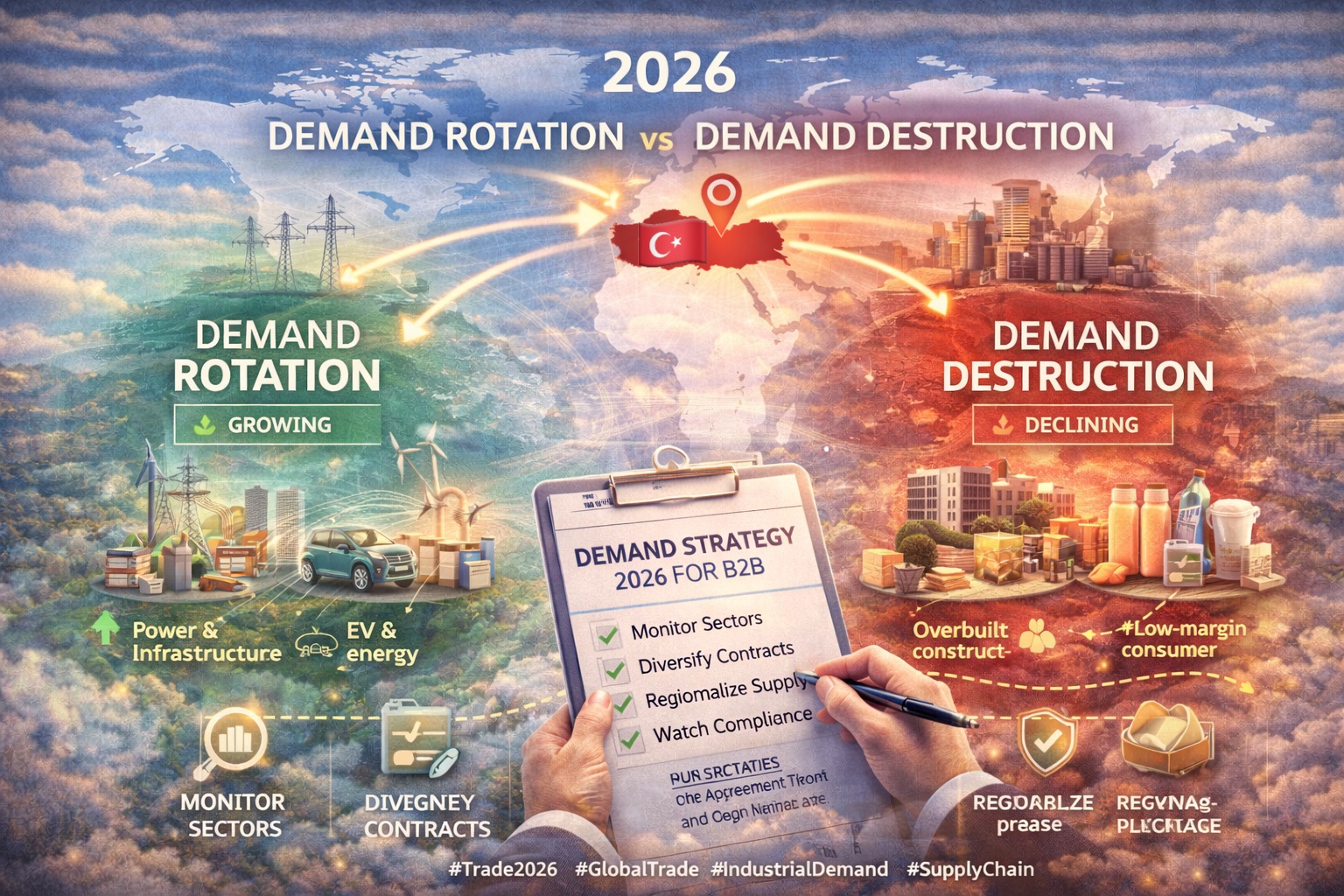
1. Demand Destruction vs Demand Rotation — What’s the Difference?
✅ Demand Destruction
Demand destruction occurs when consumption declines structurally due to:
-
Reduced end-user purchasing power
-
Long-term efficiency gains
-
Market saturation
-
Substitution by alternative materials
Example: Some packaging applications reducing polymer usage via lightweighting and recycled content mandates.
✅ Demand Rotation
Demand rotation occurs when demand shifts to:
-
New industries (EV, grid, renewables)
-
New regions (Asia/MENA manufacturing growth)
-
New formats (higher purity, specialized grades)
-
New supplier countries (regionalization, nearshoring)
In 2026, the global industrial market is experiencing more rotation than destruction—but only for firms positioned correctly.
2. The 3 Macro Forces Driving Demand Rotation in 2026
Force #1: Electrification & Grid Expansion
Demand rotates toward:
-
Copper and aluminum
-
Battery materials supply chains
-
Power transmission infrastructure
-
Industrial gases for advanced manufacturing
Force #2: Regional Manufacturing Rebalancing
Manufacturing growth is shifting toward:
-
Türkiye as nearshore production for EU
-
GCC and MENA downstream expansion
-
India’s industrial scaling
-
Southeast Asia’s electronics & packaging growth
Force #3: Regulation-Driven Material Shifts
Demand moves from generic commodity grades to:
-
Low-carbon products
-
Verified-compliance suppliers (CBAM readiness)
-
Higher efficiency inputs
-
Specialty chemicals replacing legacy formulas
Regulation is not only restricting—it’s reallocating demand.
3. Which Sectors Will Grow in 2026 (Rotation Winners)
Not everything is slowing down. In 2026, major rotation winners include:
✅ 1) Power & Infrastructure
Increased consumption of:
-
steel products
-
aluminum
-
insulation materials
-
industrial chemicals for construction
✅ 2) EV & Mobility Supply Chain
Increased demand for:
-
copper wire rod
-
polymers for lightweighting
-
specialty solvents & adhesives
-
battery-grade materials
✅ 3) Food, Hygiene & Pharma-Driven Chemicals
Stable or rising demand for:
-
IPA and hygiene inputs
-
packaging-grade polymers
-
CO₂ and industrial gases
-
specialty additives
These sectors remain resilient even under macro tightening.
4. Where Demand Weakens in 2026 (Destruction Zones)
Demand destruction is real in specific pockets:
-
Overbuilt construction cycles in certain regions
-
Low-margin consumer goods segments
-
Industries facing substitution pressure
-
Businesses with high financing sensitivity
Common pattern:
Demand does not collapse — it becomes price-sensitive and shifts to cheaper suppliers.
This is why 2026 will reward exporters who can offer:
-
flexible pricing
-
shorter lead times
-
optimized Incoterms
-
regional delivery capability
5. Türkiye’s Role in Demand Rotation Strategy
Türkiye benefits from demand rotation in 2026 for three reasons:
-
Nearshoring into Europe
Shorter lead times than Asia, with flexible fulfillment. -
Bridge into MENA & CIS
Trade corridors expand demand access. -
Adaptive Trade Models
Free zones, bonded warehousing, multi-Incoterm execution.
This makes Türkiye not only a supplier location but a demand response platform.
In practice, buyers will increasingly source through Türkiye when they need:
✔ speed
✔ flexibility
✔ compliance readiness
✔ regional balancing
6. Procurement Playbook for 2026: How Buyers Should Adapt
If you manage industrial procurement in 2026, the core goal becomes:
Buy where demand is rotating, not where it used to be.
Recommended strategy:
📌 Rebuild forecasts by sector, not by “overall market”
📌 Split contracts by rotation sensitivity
📌 Use Türkiye-based stock buffers when lead time matters
📌 Shift toward suppliers with compliance documentation
📌 Watch production indicators: PMI, energy, freight, capex trends
📌 Secure flexible supply that can “move with demand”
The procurement teams that win in 2026 will operate more like market strategists, not just negotiators.
Conclusion — 2026 Won’t Be About “More or Less Demand”
The industrial demand outlook 2026 is not a simple growth or recession story. It is a reallocation story.
Demand will rotate into:
-
electrification
-
infrastructure
-
compliant supply chains
-
regionalized manufacturing
And it will fade in legacy, low-margin, high-cost sectors.
In 2026, success comes from being positioned where demand is moving next — not where it was last cycle.
Internal Linking Suggestions:
-
Raykan Products → /products
-
Logistics & Trade Services → /services
-
About Company → /about us
-
Contact → /contact us
about
Raykan
Together, let’s shape the future of industry. Focused on Reliability, Quality & Value