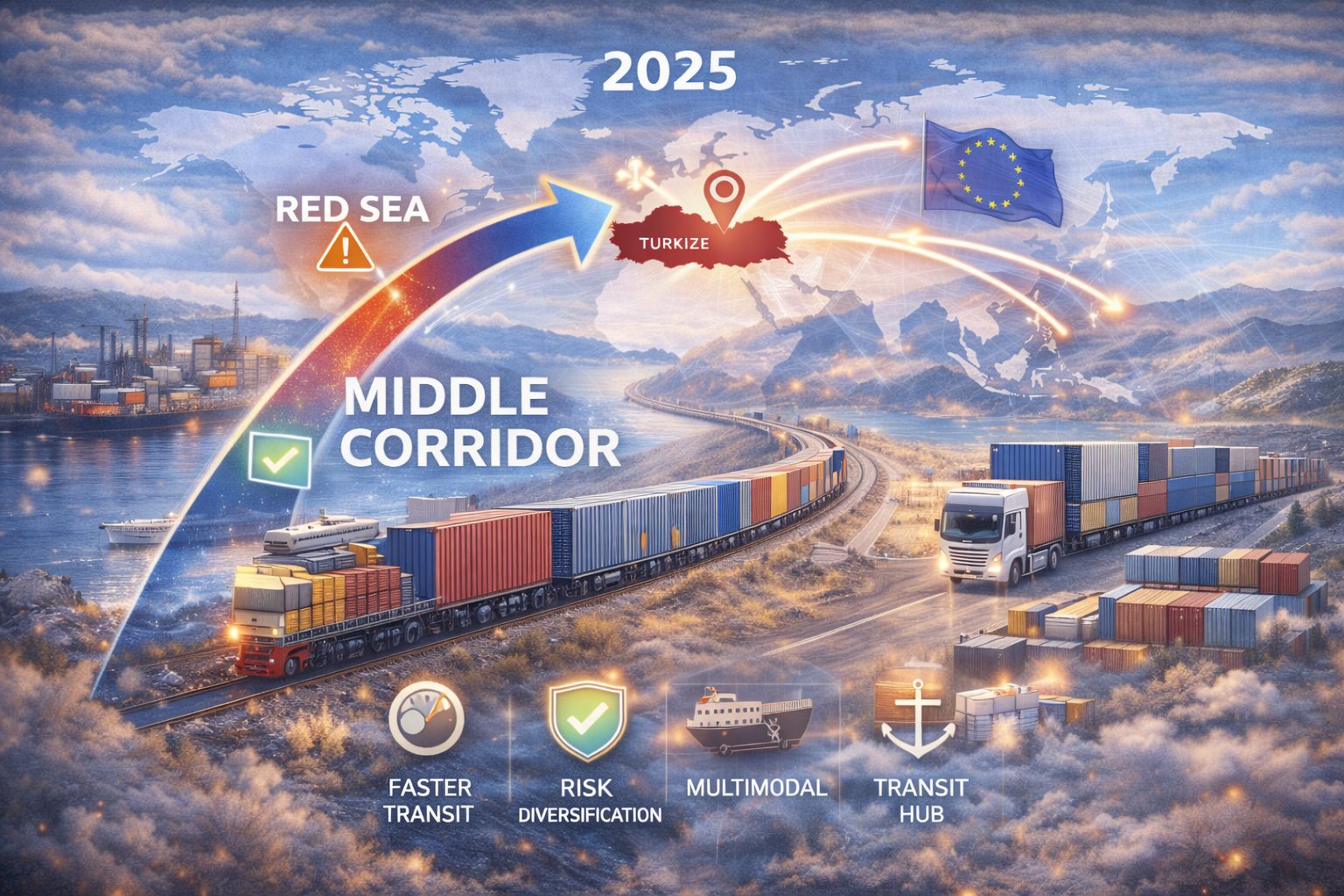
Global trade between Europe and Asia is undergoing its most significant structural shift since the early 2000s. What began as a temporary response to Red Sea disruptions has evolved into a long-term rerouting of supply chains, driven by risk mitigation, delivery reliability, and geopolitical recalibration.
In 2025, the focus is no longer on whether EU–Asia trade will reroute, but where it will settle. The answer increasingly points to the Middle Corridor, with Türkiye emerging as a central transit, consolidation, and execution hub.
This article analyzes the real drivers behind EU–Asia trade rerouting in 2025, the role of the Middle Corridor, and what this shift means for industrial buyers, traders, and manufacturers.
1. Why Traditional EU–Asia Routes Are Losing Reliability
For decades, the Suez–Red Sea corridor dominated EU–Asia trade. In 2025, that dominance is no longer guaranteed.
Key pressure points:
| Disruption Factor | Trade Impact |
| Red Sea security risks | Route uncertainty |
| Insurance premium surges | Higher landed costs |
| Transit delays | Inventory risk |
| Carrier capacity imbalance | Unpredictable schedules |
| Regulatory bottlenecks | Contract instability |
The result is not a full abandonment of maritime routes, but a risk-driven diversification strategy. Buyers and logistics planners now prioritize route optionality over lowest nominal cost.
2. What Is the Middle Corridor — and Why It Matters Now
The Middle Corridor connects China and Central Asia to Europe via:
China → Central Asia → Caspian Sea → Caucasus → Türkiye → Europe
In the past, this route was seen as niche. In 2025, it has become strategically relevant due to three factors:
-
Shorter transit time than traditional sea routes
-
Reduced geopolitical choke points
-
Multimodal flexibility (rail, sea, road)
For high-value, time-sensitive, or disruption-exposed cargo, the Middle Corridor offers a compelling alternative.
3. Türkiye’s Role as the Anchor of the Middle Corridor
Türkiye is not just a transit country — it is the execution center of the Middle Corridor.
Why Türkiye stands out:
-
Direct access to EU markets
-
Advanced port infrastructure
-
Developed road and rail networks
-
Industrial warehousing & free zones
-
Experience in multimodal logistics
In practice, many trade flows now follow this structure:
Asia → Middle Corridor → Türkiye (storage / conversion / consolidation) → EU
This allows companies to:
✔ Split long-haul risk
✔ Adjust Incoterms mid-route
✔ Optimize delivery timing
✔ Reduce exposure to single-route failure
Türkiye transforms rerouting from a logistics workaround into a commercial strategy.
4. Which Industries Benefit Most from EU–Asia Rerouting
Not all cargo justifies alternative routing. The biggest beneficiaries in 2025 are:
-
Petrochemicals & polymers
-
Specialty chemicals
-
Industrial metals & alloys
-
Machinery & components
-
Semi-finished goods
These sectors value predictability and timing as much as cost. The Middle Corridor offers a balance between speed, resilience, and commercial flexibility.
5. Cost vs Risk: The New Trade Equation
One of the biggest misconceptions about rerouting is cost.
Yes, Middle Corridor routes can be more expensive per unit.
But they often reduce total supply chain cost by:
-
Lower inventory holding
-
Fewer emergency shipments
-
Reduced disruption penalties
-
Better production planning
In 2025, buyers increasingly evaluate routes based on risk-adjusted cost, not freight rates alone.
6. Contract & Incoterm Implications
Trade rerouting is forcing contract redesign.
Key shifts:
-
More FCA / DAP Türkiye contracts
-
Hybrid Incoterm execution
-
Flexible delivery windows
-
Route-change clauses
Türkiye’s role allows buyers to pause, redirect, or reprice cargo closer to final destination — a critical advantage in volatile markets.
Conclusion — Rerouting Is Now Structural, Not Temporary
EU–Asia trade rerouting in 2025 is not a short-term reaction. It is a structural recalibration of global supply chains, driven by risk, resilience, and strategic control.
The Middle Corridor and Türkiye are at the heart of this shift, offering buyers and traders a new operating model: diversified routes, flexible execution, and reduced dependency on fragile chokepoints.
In the new era of global trade, resilience is the real efficiency.
Internal Linking Suggestions:
-
Raykan Products → /products
-
Logistics & Trade Services → /services
-
About Company → /about us
-
Contact → /contact us
about
Raykan
Together, let’s shape the future of industry. Focused on Reliability, Quality & Value